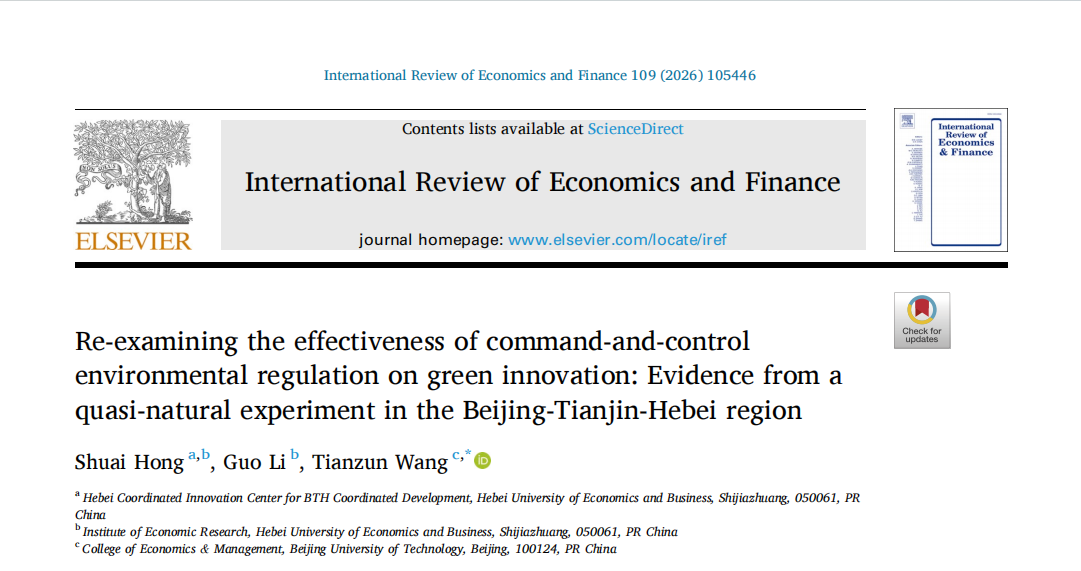
近日,洪帅博士及硕士研究生李果、北京工业大学博士研究生王天尊合作论文《Re-examining the effectiveness of command-and-control environmental regulation on green innovation: Evidence from a quasi-natural experiment in the Beijing-Tianjin-Hebei region》在《International Review of Economics and Finance》发表。
ABSTRACT
Green innovation is an advanced driver and key catalyst for regional high-quality development, while environmental regulation provides an important policy guarantee and institutional framework for fostering regional green innovation. Moving beyond the traditional paradigm that examines a single policy instrument in isolation, this study re-examines the effectiveness of command-and-control environmental regulation within the unique institutional context of government-led regional collaborative governance in China. Using panel data for 81 cities in the Beijing-Tianjin-Hebei (BTH) region and surrounding provinces from 2008 to 2021, we employ a quasi-natural experimental design to evaluate the effect of the Coordinated Development Strategy of Beijing-Tianjin-Hebei (CDSBTH) on regional green innovation. The findings show that CDSBTH effectively promotes regional green innovation by strengthening command-and-control environmental regulation. The policy effect varies significantly across different types of cities in the BTH region. Under a systematic and mandatory regional top-level design, traditional command�and-control environmental regulation can be transformed into an effective drivers of green innovation. This study verifies and enriches the applicability of the Porter hypothesis under specific governance structures and provides both a theoretical case from the Chinese context and policy implications for other developing countries seeking achieve green technology catch-up through policy intervention.